
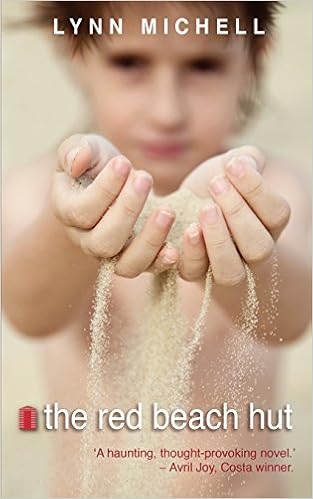
I’m excited to be able to share an extract of the intriguing The Red Beach Hut by Lynn Michell with you today. Huge apologies to the lovely Nicola Sweeney for being late with this blog post due to a few rather hectic days.
The Red Beach Hut is now available to buy in paperback and in eBook where it is currently only £1.99.
Book Synopsis:
Their eyes met and locked. Pulling his hand from his pocket, Neville waved. Once.”
Eight year old Neville is the first to notice that the red beach hut is occupied again.
Abbott, panicked by what he believes is a homophobic cyber attack, is on the run. The hut is his refuge and shelter.
Inevitably man and boy collide. Their fleeting friendship is poignant, honest and healing. But Abbot’s past threatens to tear him away, as others watch and self-interpret what they see.
An evocative portrayal of two outsiders who find companionship on a lonely beach, Lynn Michell’s novel is about the labels we give people who are different, and the harm that ensues.
Extract:
At this hour there were of course no taxis, which was fine because to show his face would have been risky. It was less than three miles to the beach and after sitting rigid and tense with the rattle of clickety-click wheels in his ears, he needed the walk and the fresh air even with his ludicrously unwieldy luggage. The main road, at first a long lonely stretch of nothingness, reached B&B land, then sprouted arteries to the left which wound downhill towards and through the town centre: past the tourist shops, their stands of t-shirts and flip-flops pulled inside behind shutters for the night, past Tesco Lifestyle, past pizza places where faded photos of meals cello-taped in the windows told the punters what they could eat, past hairdressers and nail bars and betting shops and slot machine arcades. Neon lights gave the place a garish pallor and made it sadly old-fashioned, though perhaps by daylight it would look just the same. It didn’t matter. He would live facing away from all of this, venturing up the hill from the promenade only for provisions. The summer would soon be gone and the shops and cafes would close until the following year. The resort would die, leaving the old folk who always lived here and the dwindling numbers of families and single men who could find winter work. The young left for the big cities the minute the doors closed on their school careers. Better to stack shelves than to stay here.
At the bottom of the hill, a line of bollards marked the end of access to vehicles and the start of the concrete pedestrian promenade that ran above the beach, giving access to the sands every fifty or so metres down a flight of steps. The stalls dotted along the way, like the shops, were shut up for the night, but he noted that this was where he could come for easy food when he didn’t feel like preparing meals himself. Half-way along the promenade, a brightly coloured wall rose up, surprising visitors who had expected to see discreet shades of cream and white. A relic from another era, these beach huts had acquired an unexpected nostalgia and popularity, had been gentrified, and were valued by town folk and holiday makers alike. His aunt’s was the last but one. She had always wanted to paint it a deep turquoise to match the sea on the sunniest day but the rules for cosmetic changes to the exterior were strict and many. Seven colours were permitted and turquoise wasn’t one of them, so red it stayed. Yes, there it was.
There’s no-one watching, you idiot. Not a soul on the beach but you, he told himself without conviction as he walked along the concrete, placing one careful foot in front of the other and holding his holdall in both arms so that it did not make a noise banging against his legs. His arm muscles screamed. No light shone from any of the huts below and he knew that apart from his aunt, people did not sleep in them. At least they hadn’t when he was a kid. But fear and lack of sleep dumbed down reason and he told himself someone might be staying the night.
Students. Squatters. Someone eccentric like my aunt. Someone on the run like me.
Reaching the farthest end where there were no more steps, he hung his bag and rucksack from the ends of his aching arms, as far as he could reach, before letting go. He winced as they landed with barely a thump. Then he bent his knees and jumped, aiming for the quietest possible landing on the sand. The very soft thud made his heart race and he waited at the end of the line of huts for several minutes before moving or poking his head round the corner. A fleeting glimpse.
Nothing. Nobody.
The end hut where he was now standing had the luxury of a side window and with a brief look inside, he reassured himself that this one was definitely empty. He looked in again for longer. Deck chairs and small tables were folded and stacked against the far wall, and other stuff was packed away in boxes, suggesting the owners had left and might not be back this season. It looked too neat and tidy and swept to be a quick end-of-day clearance before another day on the beach. He picked up his bags and began a breath-held walk from the end hut to his own. Yes, his own. In his pocket, he felt for the keys on their dolphin chain.
It was with guilty, worried speed that he fumbled the key into the lock, pushed open the red door and got himself and his bags inside. Five seconds. He closed the door very softly behind him and for the first time since he’d come back from lunch to find his computer hacked, he let his shoulders droop. Leaning against the door, he closed his eyes and permitted himself a slow outward breath of relief. Whatever happened, he had a few days of precious time here to think it through, to reflect on the magnitude of what he’d done and to come to terms with whatever consequences might follow. But right now, in this red cell, they didn’t matter. Now mattered. The very early hours of today mattered. And tomorrow – when it came. And the next day.
With weary, travel-sore eyes, he looked around. Apart from the musty unused smell of a hut that had been shut up for more than a year and the layer of fine sand that had blown under the crack below the door and covered every surface, this interior was a work of domestic perfection, its confined space converted into a workable, delightful home. Like a small caravan, or a campervan, only more lived-in and private. Every detail had been considered. Against the farthest wall was a platform holding a mattress with folded bedding on top and book shelves below. His aunt’s books still packed one half of the rough wooden planks while the rest of the space was filled with wicker baskets, probably for clothes, which exactly slotted into the spaces. A full-length red curtain was pushed to one side, but could be drawn across the bed, maybe to separate night from day. At the front, a window above a table was hung with the same filmy red fabric and a blind could also be pulled down to stop the light leaking out, light from a genuine old oil lamp because there was no electricity.
Peeling his body from the security of the door, Abbott went to the window, pulled down the blind and closed the curtains. His aunt had been clear-thinking enough to have left matches next to the lamp. Abbott lifted the glass cover, turned up the wick, struck a match and held it close. Little beads of fire sizzled around the wick before flaring confidently into creamy flames which he turned down and tuned to a rich pulsing glow that filled the space with welcoming light.
About The Author:

Once upon a time I had a day job as an academic lecturing in English and Psychology. Later I did research that was a bit like anthropology: I spent one year in a Glasgow secondary school recording my conversations with teenagers and finding out what it was like to be them. I have always been interested in writing up the lives of other people and giving them a voice.
Then I became ill. Very, very ill. Not just me, but my two sons and several academics in my husband’s department. We all had ME. I tried going back to work after six years but only lasted eighteen months before a severe relapse.
Seven years on, I tried to exit the ME ghetto again. I ran a gentle, weekly creative writing class at The Salisbury Centre in Edinburgh. I discovered that I loved working with writers, was good at mentoring and above all was passionate about good prose. I set up Linen Press as a natural next step.
I have always written. I must be a very slow learner, not recognising that I should have stuck with writing and editing all along. The world of books is where I belong. It is satisfying to work closely with my authors and to turn a promising manuscript into a beautiful book, and I revel in each unique and challenging publisher-writer relationship.
Recently there have been big changes in my personal life. Seven years ago we started work on a half-built house on a rocky, isolated hillside in France. Now completion is in sight. Six years ago, I become the grandmother of twin girls. Incredibly, in April 2017, another set of twin girls were born. Two sons, both with twin girls when we have none in our families—more female stories unfolding.
Lynn’s books published by Linen Press
White Lies (Accepted for publication in hardback by Quartet Books)
Shooting Stars are the Flying Fish of the Night (with Stefan Gregory)
Lynn’s books published by other publishers
Write From The Start. Oliver & Boyd.
Growing Up in Smoke. Pluto Press.
A Stranger At My Table: Mothering Adolescents. (Ed) The Women’s Press.
Shattered: Life With ME. HarperCollins.
Wild On Her Blue Days. (Ed). AmberSand Press.
Letters To My Semi-Detached Son: A Mother’s Story. The Women’s Press.
Run, Alice, Run IQ Press.
The Red Beach Hut. IQ Press.
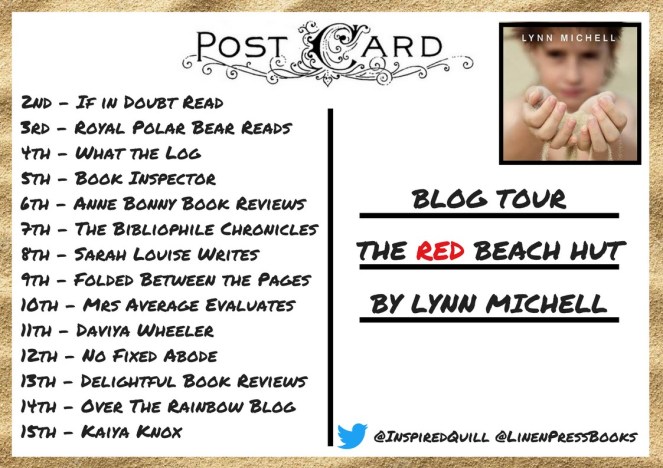
Follow The Blog Tour:
Although the blog tour is now over, do go back and visit these bloggers to find out what they thought of The Red Beach Hut.

 Over The Rainbow Blog