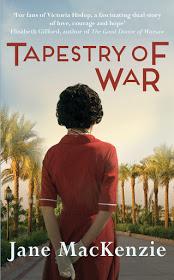
I’m thrilled to be able to share an extract of The Tapestry Of War by Jane Mackenzie today. Apologies to Ailsa for being late posting this, life is a little hectic with three children sometimes.
Tapestry Of War is published today in ebook and paperback on the 20th September 2018 and you can purchase or pre-order a copyhere.
Before I share the extract with you here is a little about the book.
Book Blurb:
From the deserts of North Africa, to the waters of Scotland, the Second World War touches the lives of two women from two very different worlds. In Alexandria, Fran finds her world turned upside down as Rommel’s forces advance on the idyllic shores of Egypt. The life of luxury and stability that she is used to is taken away as she finds herself having to deal with loss, heartache and political uncertainty. Meanwhile, in the Firth of Clyde, Catriona struggles between her quiet rural life and her dreams of nursing injured servicemen on the front lines. As the war rages on, the two women’s lives become intertwined – bringing love and friendship to both.
Extract:
This extract is from Chapter Two, Chapter One is currently available on the publisher’s website http://www.allisonandbusby.com/booksample/tapestry-of-war-chapter-sample.pdf
Chapter Two
It was tough to go to work that morning, but it was only a half-day, being Saturday, and Fran plodded through it, using her time to write a piece about yesterday evening’s battle between the rival French forces.
The Alexandria Journal was housed in a narrow building in the old town. It was a weekly paper targeted at all of the expatriate and business communities, one of two main English language papers that vied for readership with each other.
Fran had been writing the occasional piece for the paper for some years now, but things had changed when the Journal lost half of its staff at the outbreak of war. There had been three Italian employees who had been placed in internment alongside all Italian males when they became the ‘enemy’. Then the one full-time English reporter had left to work for the Foreign Office in Cairo. So the ancient editor, Tim Jeffrey, had invited Fran to join the paper full-time, and she had found her place in a man’s world, splitting her time between managing the office, liaising with the printing press, editing the work of the outside journalists, and writing the weekly editorials with Tim. It suited her rather vigorous spirit to have a lot of variety in her life, and to be busy. And that they were, for sure, since with so many old staff now gone those who remained were spread very thin.
The Alexandria Journal was never going to rival the daily Cairo papers for off-the-press news, but the paper’s unstated goal was to keep the communities of Alexandria together – no easy feat when the city was so cosmopolitan. There were several nationalities living side by side here, and their home governments held some very different positions in the war.
‘No anti-French propaganda,’ Tim told Fran when she started. ‘And let’s be clear that most of our Italian community here don’t deserve what is happening to them. There are lots of people being badly bombed here who have nothing to do with this war, and somehow we’ve got to write for them. Tell the truth, as far as we can get hold of it, and let’s tell the human story too, of what people are doing to help each other and our troops here in Alexandria.’
It was all very well, Fran thought, and she could understand the need to boost morale, and not inflame a delicately balanced community, but people weren’t stupid. Things were going disastrously just now in the war, and pretending otherwise would fool no one, and the British were so often wrong in how they managed things here in Egypt. Everyone knew it, and many resented it.
A lot of the time, when reporting on local events or the disastrous price of cotton, the newspaper looked not much different from its pre-war years, and for people nervous about their futures, routine reporting was reassuring. But Tim’s instructions left her some leeway to delve into a good story, and she did so whenever she could.
No anti-French propaganda, Tim had said. That was because so many of the community here had links to France, by education, by birth, by friendship. But she could challenge what Naval Command were doing with the French navy here in Alexandria. The Brits had interned the French ships, but were paying the men on board them a salary, and leaving them completely free to roam the city, to socialise and spread whatever propaganda they wanted. That was the problem, wasn’t it? One day hopefully France would take up arms again against Germany, but meanwhile a lot of these men were known to be doing everything they could to undermine the Allies, insidiously, through negative talk and leaks about Allied movements. Surely giving the men so much freedom would lead to more and more raging battles like last night’s, more anger, more knives in the ribs? It was a subject that needed debate.
Fran was aware that she wrote differently that morning to how she would have written a week ago. The young French matelot was always on her mind. She fretted over how he was doing. Had they given him a transfusion? What did you do other than that for injuries like his? And she found herself wondering about the young matelot himself. Where was he from in France? How did he feel about his treatment by the British? Had he goaded the Free French, or had they attacked unprovoked? She needed his point of view, and she wanted to see him again so that she could ask him.
She ran her questions past their new trainee, a fresh high school graduate named Asher. ‘He didn’t look much older than you,’ she told him. ‘Do you see the matelots out and about when you go out for the evening?’
‘Sometimes,’ he answered, ‘but to be honest I spend more time playing football than out on the town. They don’t have a football team, I do know that! Was he badly hurt?’
She nodded. ‘Pretty badly.’ She pictured the young man as she’d seen him last, grey as the morning mist, strapped helplessly to the hospital stretcher. Had he been back at home in France maybe he too would have been playing football instead of roaming the streets. Asher came from a close Jewish family, and went home each night to his mother’s kosher cooking. The matelot was living by contrast in a pretty tough man’s world.
‘He’ll be fine, you know, Miss Trevillian,’ Asher said. ‘I don’t think they’d have lied to you about that.’
She smiled rather wearily. ‘I hope so. I’d like to see him.’
‘You’ll visit him in the hospital? Can I come too?’
She smiled again at his enthusiasm. ‘You can tidy this paperwork first, young Asher! And pop that envelope down to the print. Then we go off for the weekend. We’ve got a couple of days to worry about the article before the paper comes out. It’s a good job, because I’m beyond writing any more today. I’m dead on my feet.’
She left the office for once at the same time as the rest of her staff that lunchtime. She made her way home on the tram and, finding both her parents out, ate a quiet lunch prepared by their cook Ahmed, and then headed gratefully for a long sleep.
About The Author:

Jane MacKenzie has spent much of her adult life travelling the world, teaching English and French everywhere from the Gambia to Papua New Guinea to Bahrain, and recently working for two years at CERN in Geneva. She now splits her time between her self-built house in Collioure, France and the Highlands of Scotland, where she has made her family home.
Follow The Blog Tour:
If you liked the sound of this book from the extract I shared please follow the blog tour and find out what these other fabulous bloggers are saying.




 Over The Rainbow Blog