

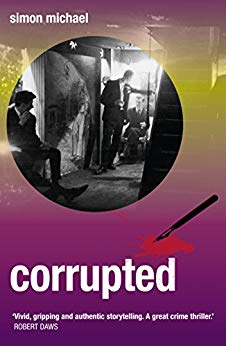
I’m excited to be on the blog tour for this fantastic sounding book today. Thanks so much to the lovely Kelly for being so understanding when I got the date of the book tour wrong.
Corrupted is available in ebook and paperback now. The ebook is currently only 99p and you can purchase a copy of both here.
Before I share my extract with you here is a little about the book.
Extract:
chapter 1
friday, 26 june 1964
10.00 hours
Charles Holborne pushes open the double doors of the Old Bailey robing room, heavy slabs of oak darkened and made shiny by years of barristers’ sweaty palms. At ten o’clock this is usually the busiest time of the day, but the end of the Trinity court term approaches and the robing room is only half full, as barristers whose cases have finished and whose children have already returned from their boarding schools slip away early for summer holidays before the hordes of state school kids and their families.
Charles Holborne looks like an Italian truck driver. His forearms are enormous hams that complement tree-trunk legs. His shoulders are of a width that requires bespoke tai- loring and he possesses black eyes, dark curly hair and an olive complexion. He currently sports a healing cut to his left eyebrow and faint evidence of a black eye, and a careful observer might note that his nose is no longer quite straight. First impressions are of a swarthy bruiser not averse to a fight. However, Charles Holborne, né Charlie Horowitz, is supposedly a cultured and successful criminal barrister, and one at the top of his game. It is only weeks since his highest profile case yet, a dock brief still being referred to in the newspapers as The Thames Murder Case. Despite all the odds, most of the evidence and several corrupt police officers ranged against him, Charles secured an acquittal and saved the lives of both his client and himself. Since then he has been deluged with work. Today’s speech in Court 1 of the Central Criminal Court, the Old Bailey, will conclude the second back-to-back murder trial in which he has been instructed – both, importantly, for the Crown – and two more await his attention in Chambers. It’s being said, once again, that he’s the up-and-coming junior destined for great things.
Charles elbows his way gently past counsel jockeying for position in front of the mirrors to tie their bands and adjust their wigs. He is amused to note how many make the effort to greet him and smile – a sharp contrast to the year before when he was persona non grata with his professional colleagues. Being charged with murdering your wife, the daughter of the viscount who was also once your head of Chambers will do that, he thinks wryly. Being an East End Jew with a bit of a past doesn’t help either. Now, however, the public face of his profession professes him fully rehabili- tated: cleared of murder and of proven integrity – despite all rumours to the contrary. Now, he is tipped for silk: promo- tion to one of ‘Her Majesty’s Counsel learned in the law’, next April. Having spent all his life as an outsider, Charles finds himself inexplicably popular. He has even reached a form of uncomfortable truce with the Twins, whose lives he cannot disentangle from his, however he tries; those community- spirited sociopaths who refuse to remain in his past, the gangland rulers of London, Ronnie and Reggie Kray.
So Charles smiles, without for a second trusting this new-found popularity. It’s an illusion, he reminds himself as he reaches his locker at the end of the row; painted smiles on whoreson faces. Whatever they say to my face, I’ll still be outside the circle. His mother is wont to express it in blunter terms: ‘Scratch any Englishman, and beneath the surface you’ll find an anti-Semite.’ Millie Horowitz, lately of Mile End and now of Golders Green, milliner and devoutly inward-looking Jewess, could never feel comfort- able in English society and will never understand why her elder son wanted to join the ranks of a profession that would despise him. Charles is prone to remark that his mother acts like a first-generation frightened immigrant, not someone whose family has in fact lived in London for four centuries. But in the Jewish East End, surrounded by kosher butchers, bakers and candlestick-makers, living a few hundred yards from her synagogue in one direction and the family business in the other, she never needed to venture outside her own community. ‘Outside’ was unknown and daunting, and her son’s choices, to anglicise his name, to marry out – in short, to be part of a wider world – are incomprehensible to her; they constitute an unforgiveable rejection of everything she holds dear.
Charles stands in front of his locker, which bears a card
in an elegant copperplate hand proclaiming that it belongs to Charles Holborne, Esq.. He places his wig tin on the enormous oval table where it joins a shoal of other identical shiny black tins, and opens it to take out his wig. He smells the yellow and grey horsehair tentatively, and reluctantly acknowledges that the last weeks of high-stress sweat-inducing murder trials will require the wig to be professionally cleaned again during the vacation. He hates the seventeenth-century anachronism represented by his court dress and refuses to wear the wig until the last possible moment before the judge enters court. It’s an idiosyncrasy by which he has become well known, and for which he has been berated on a couple of occasions when caught out by judges returning unexpect- edly to their benches.
Charles finishes changing, closes his locker and collects his papers. He leaves the chatter of the robing room behind him and descends the staircase to Court 1. He pushes open the doors and walks down the aisle. The dock towers above him, but it is vacant, as are the barristers’ benches and the jury box. Higher still, in the public gallery, the first specta- tors are filing in, folding umbrellas and shaking rain from wet raincoats. Charles slides into the junior barristers’ bench, wondering if this time next year he’ll be occupying the bench in front as a QC, and pulls the bow on the white ribbon on his brief. The white ribbon is also new: red for defence briefs, white for prosecution.
Twenty minutes later the court is packed with barris- ters, solicitors, members of the public and the jury. At a nod from the judge Charles rises to deliver his closing speech. The accused, a thirty-year-old woman, is supposed to have murdered her abusive husband by hitting him over the head with a rolling pin after one complaint too many concern- ing the quality of her cooking. Her defence – self-defence
– had appeared almost hopeless when Charles first read the depositions. The police found plenty of evidence that the deceased had thrown his supper at the accused – on their arrival she’d been sobbing on the kitchen floor next to her husband’s body, gravy and shards of crockery in her hair and a cut to her forehead – but Charles hadn’t thought it possible to elevate a thrown plate into such a fear of attack that it became reasonable to bash the late gourmet several times over the head with a rolling pin. Nonetheless, defence counsel had made the most of a thin case and had the advan- tage of a jury composed, unusually, of eight women and four men.
Having invited the jury to convict the unfortunate house- wife, Charles resumes his seat and allows his opponent to rise. Charles listens with interest and approval to the speech for the defence. Michael Levy QC, a recently appointed silk with a soft Glaswegian accent and a deviated septum (the result, variously, of a fight in an Edinburgh pub, a car crash or a cricket ball, depending on which story Levy is telling at the time) is an old friend of Charles’s. They met during pupillage, recognised each other as kindred spirits, and shared their respective horror stories and examples of anti- Semitism over the cheapest glasses of red wine sold by El Vino’s on Fleet Street. Although the two men are less close now than during their pupillage year, Charles is still very fond of Levy, his inexhaustible supply of almost-believable stories and his tendency to irrepressible giggling, even when in court. On one memorable occasion he and Charles had been co-defending before the Recorder of London, and had reduced one another to tearful near-hysteria with laughter over something that occurred in court. With the jury still in court, they’d been made to stand like naughty schoolboys while berated by the Recorder.
The Glaswegian makes the most of a bad job and a difficult case, on several occasions making the members of the jury laugh as he attempts to fan a smouldering ember into the steady flame of ‘reasonable doubt’. However, within ten minutes of the judge starting his summing up of the evidence, the judicial boot has been so firmly put into the defence case that Charles knows the faint hope of acquittal has been extinguished. And so it proves. Little more than an hour later, the jury having convicted the accused and she having been tearfully remanded into custody for social reports, Charles makes his way back to the robing room.
‘Well done,’ say a number of colleagues as he passes. ‘Another good win.’
It doesn’t feel merited.
As he is about to push open the door of the robing room, Charles hears a young voice behind him.
‘Sir?’
Charles turns to see a bright and spotty-faced youth, the most recent addition to Chambers’ clerking team, his arm outstretched.
‘Afternoon, Clive. What’re you doing here?’
‘I went on my first tea party, sir,’ replies the lad with pride, referring to the High Court listing appointment at which clerks attempt to get their guvnors’ trials listed at a time when they are available, thereby avoiding having to return their best cases. ‘And Barbara asked me to pop along and give you this.’
He proffers a folded slip of paper which Charles takes. ‘Thanks,’ says Charles, and the clerk turns and skips back down the steps.
Charles opens the piece of paper and reads: Prospect tomorrow19.00? It is signed The other one-armed bandit. Charles smiles with pleasure, and pockets the note.
About The Author:

Simon Michael is the author of the best-selling London 1960s noir gangster series featuring his antihero barrister, Charles Holborne. Simon writes from personal experience: a barrister for 37 years, he worked in the Old Bailey and other criminal courts defending and prosecuting a wide selection of murderers, armed robbers, con artists and other assorted villainy. The 1960s was the “Wild West” of British justice, a time when the Krays, Richardsons and other violent gangs fought for control of London’s organised crime, and the corrupt Metropolitan Police beat up suspects, twisted evidence and took a share of the criminal proceeds. Simon weaves into his thrillers genuine court documents from cases on which he worked on the big stories of the 1960s.
Simon was published in the UK and the USA in the 1980s and returned to writing when he retired from the law in 2016. The Charles Holborne series, The Brief, An Honest Man and The Lighterman, have all garnered strong reviews for their authenticity and excitement. Simon’s theme is alienation; Holborne, who dabbled in crime and in serious violence before becoming a barrister, is an outsider both in the East End where he grew up and in the Temples of the Law where he faces daily class and religious prejudice. He has been compared to Raymond Chandler’s Philip Marlowe and Dashiell Hammett’s Sam Spade, honourable men surrounded by corruption and violence, trying to steer an honest course.
Follow The Blog Tour:
If you liked the sound of this book from my extract please follow the blog tour and find out what these other fabulous bloggers are saying.


 Over The Rainbow Blog
I love this series Charles Holborne is one my crime fiction favourite characters.
LikeLike