
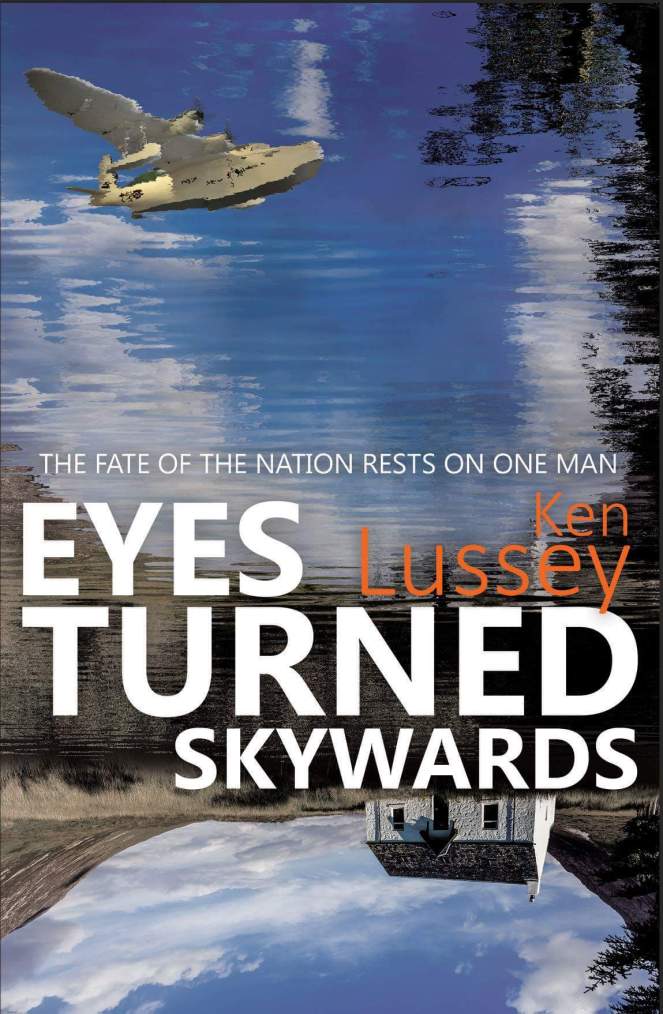
I’m on the blog tour for Eyes Turned Skywards by Ken Lussey today and have a great extract to share.
Eyes Turned Skywards is available in ebook and paperback now, you can purchase a copy of both here.
Before I share my guest post with you here is a little about the book.
Book Synopsis:
This novel reflects on the rumours and theories surrounding a number of real-life events, including the death of the Duke of Kent and the aircraft crashes of Short Sunderland W4032 and Avro Anson DJ106.
Wing Commander Robert Sutherland has left his days as a pre-war detective far behind him. Or so he thinks. On 25 August 1942 the Duke of Kent, brother of King George VI, is killed in northern Scotland in an unexplained air crash; a second crash soon after suggests a shared, possibly sinister, cause. Bob Sutherland is tasked with visiting the aircraft’s base in Oban and the first crash site in Caithness to gather clues as to who might have had reason to sabotage one, or both, of the aircraft.
Set against the background of a country that is far from united behind Winston Churchill, and the ever-present threat from the enemy, we follow Bob as he unravels layers of deceit and intrigue far beyond anything he expects.
Guest Post:
Eyes Turned Skywards: Background and Research
It’s sometimes easy to forget exactly where an idea began. The idea for Eyes Turned Skywards came, indirectly, from a book I was reading about the Banff Strike Wing. This was a powerful force of anti-shipping aircraft based at RAF Banff in northern Aberdeenshire during World War II whose job was to disrupt enemy shipping along the coast of Norway. A couple of the real-world incidents that occurred were in the “truth is stranger than fiction” category. Why not write a novel that took these as its starting point?
There was a problem, however. The Banff Strike Wing was at its most active in the final nine months of the war. What I had in mind felt like the first in a series of books. If I began the series in September 1944, then there was only limited scope for further books before the war came to an end. Much better, I thought, to put the idea on one side for the moment, and look for something equally intriguing to begin the series, rather earlier in the war.
It didn’t take long to realise that the death of the Duke of Kent on 25 August 1942 provided exactly the sort of intrigue I was seeking. Prince George, Duke of Kent, was the younger brother of King George VI. The air crash that killed him and thirteen other men on a remote hillside in Caithness, in a place where his aircraft should never have been, has been a mystery whose cause has, over the years, prompted many theories, some more credible than others.
This gave me a time, a place, an event, and a mystery. I had also by now unearthed some fascinating real-world characters who again fell into the “truth is stranger than fiction” category, and it was possible to build compelling fictional characters on the foundations of their real counterparts.
For locations I used a number of real places, exploring some fascinating parts of Caithness in the process. An exceedingly boggy February walk to the two memorials at the site of the crash at the heart of the mystery simply reinforced my wish to come up with a credible explanation for what happened on that day, and to weave a story around it.
Where the geography wasn’t right I helped it along a little. Sarclet Castle in the book is a rather altered Castle of Mey, relocated from the north coast of Caithness to its east coast. Dunrobin Castle, Fort George and Dunollie Castle near Oban could serve without being moved.
The process of researching the book was utterly fascinating, but there was one moment that sent chills up and down my spine. The official account of the cause of the crash that killed the Duke of Kent was given in a written answer to a parliamentary question on 7 October 1942. I’d realised early in the research that the online version of Hansard showed that the answer gave the date of the crash as 15 August 1942 instead of 25August 1942, but I’d put this down to an error that arose when the records were digitised. It was only when I visited the National Library of Scotland in Edinburgh that I realised that the wrong date was given in the original written record, which is truly remarkable given it was about what would have been at the time a very recent and very high-profile event.
Ken Lussey
lussey@arachnid.co.uk
About The Author:

Ken Lussey spent his first 17 years following his family – his father was a Royal Air Force navigator – around the world, a process that involved seven schools and a dozen different postal addresses. He went to Hull University in 1975, spending his time there meeting his wife Maureen, hitch-hiking around Great Britain, and doing just enough actual work to gain a reasonable degree in that most useful of subjects, philosophy. The next step seemed obvious. He researched and wrote A Hitch-Hiker’s Guide to Great Britain, which was published by Penguin Books in 1983.
An inexplicable regression into conformity saw him become a civil servant for the next couple of decades, during which time he fulfilled the long-held ambition of moving to Scotland.
In more recent times he has helped Maureen establish the website Undiscovered Scotland as the ultimate online guide to Scotland. Eyes Turned Skywards is his first novel.

 Over The Rainbow Blog