
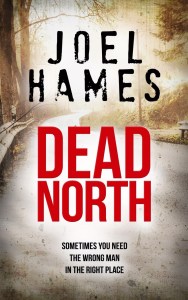
I’m on the blog tour for Dead North by Joel Hames today and an excited to be able to share an extract from this fab sounding book. I’m really looking forward to reading this soon as I have been hearing great things.
Dead North is available to buy in paperback now and in ebook on the 22nd March. You can buy or order both here.
Before I share my extract, here is a little bit about the book.
Book Description:
Once the brightest star in the legal firmament, Sam Williams has hit rock bottom, with barely a client to his name and a short-term cash problem that’s looking longer by the minute. So when he’s summoned to Manchester to help a friend crack a case involving the murder of two unarmed police officers and a suspect who won’t say a word, he jumps at the chance to resurrect his career. In Manchester he’ll struggle against resentful locals, an enigmatic defence lawyer who thinks he’s stepping on her toes, beatings, corrupt cops and people who’ll do anything to protect their secrets. On its streets, he’ll see people die. But it’s in the hills and valleys further north that Sam will face the biggest challenge of all: learning who he really is and facing down the ghosts of his past. He’s working someone else’s case and he’s in way over his head. But sometimes you need the wrong man in the right place.
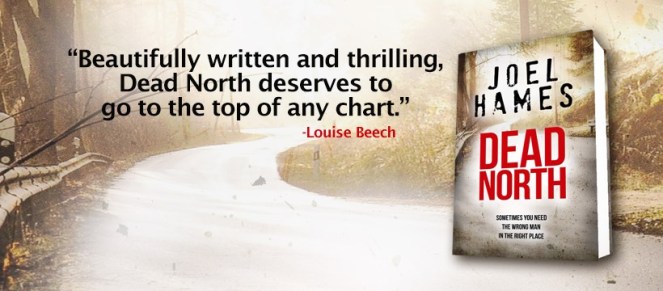
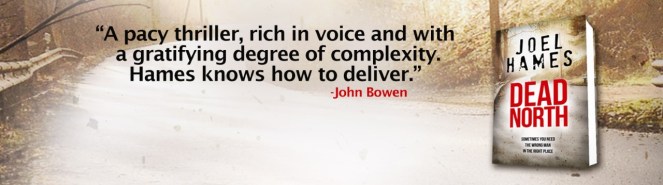
Extract from Dead North from Joel Hames
Hello Joanna, thank you for hosting me, and hello everyone else, thank you for reading.
My latest novel, Dead North, is based for the most part around Manchester, and a fictionalised version of the Forest of Bowland, a huge and beautiful area of moorland, hills, rivers and (unsurprisingly) forest that I’m lucky enough to call home.
The novel begins with the central character, lawyer Sam Williams, attending a police funeral. Two officers have been murdered, in cold blood, on a remote country lane. Sam’s friend and mentor, Detective Inspector Roarkes, has been called in to run the investigation, and Roarkes has asked Sam for help.
At one stage, I contemplated writing an alternative opening scene, based around the actual murders. It was a tricky ask, because what is described here has to be sufficiently unclear that deciphering it forms one of the main “reveals” of the novel. It’s a first person novel, and Sam isn’t present, so it has to be outside the main body of the novel. In the end, I went with the funeral, and I still think that’s the best option. But I thought it would be fun to have a try at this alternative opening. I’ve set both versions out here. When you’ve read the book, please let me know which you think works better.
PROLOGUE: THE DEAD
I DIDN’T WANT to get out of the car, but Gaddesdon wasn’t keen on me bleeding all over the upholstery again while he stood shivering outside. I told him my nose hadn’t bled since the last time someone had hit it, which was nearly two days ago now, but that cut no ice. So I stood there at the back of the cemetery and watched the gaps between the black-coated mourners as a box with a dead woman in it dropped into a hole in the earth.
There were words, but I wasn’t listening. I was thinking of other things, of glaciers and mobile phones, hidden pasts and broken bones. I corrected myself. Almost broken. I’d assumed half Folgate Police Station would be there, and they probably were, but apart from Gaddesdon, and Roarkes, standing there right in the middle and looking nearly as awkward as I felt, I didn’t recognise a soul. I took a step back and out of sight. I didn’t want Roarkes seeing me. He might ask some awkward questions.
Gaddesdon I could still see. He’d found himself a spot near the front, head bowed, shoulders hunched against the cold, a giant frozen penguin. A whole gang of frozen fucking penguins praying to their penguin god, I thought, and checked the smile before it formed.
I hadn’t known Fiona Milton. I’d never met Fiona Milton. I wasn’t a police officer, and I wasn’t from Manchester or Lancashire or wherever the hell we were. I wanted to know why she’d died, sure, but seeing her corpse buried wasn’t going to help me. I cursed Gaddesdon silently. I’d have been better off waiting in the car.
The minister had finished talking and someone else had taken his place, Fiona’s superintendent, a fierce-looking man with tiny eyes and a few strands of lank brown hair that flapped idly in the wind as he recalled her bravery, her integrity, her smile, her spirit. I wondered if he’d ever actually met her. I wondered if he’d even known who she was, before someone had come running into his office and told him she’d been gunned down on some godforsaken country lane in the middle of nowhere.
I wondered if I could slip away now, go back and sit in the car, which Gaddesdon hadn’t bothered to lock, figuring if it wasn’t safe at a police funeral it wouldn’t be safe anywhere. I glanced around, searching out eyes. I didn’t want anyone to see me. Bloody Londoner. Bloody lawyer. Sneaking off. No respect. It wouldn’t look good.
And then I heard it.
It shouldn’t really have been out of place, not at a funeral, the sound of a sniff, a prelude to tears. But this was a different kind of funeral, a defiant, stiff-backed, fist-shaking funeral. A funeral of suits and uniforms and frozen penguins, legacy and courage and all that bullshit. Not real people. Not tears.
A fat penguin shifted a few inches to the right and I saw the source of the noise. A child. Six or seven years old, I thought, a little boy in a suit that made him look even smaller than he was, his face screwed up
to fight off the tears. The tears were winning. There was a girl beside him, a year or two older, holding his hand, turning to whisper in his ear. And behind them both a man, about my own age, one arm on each of their shoulders, staring fixedly ahead, as though he could see something there the rest of us couldn’t, lips pressed tightly together. Jaw trembling.
The other victim had already been buried. I remembered what Gaddesdon had told me about Naz Ahmet, Fiona Milton’s colleague. Same uniform. Same car. Same death. Another funeral, another superintendent, or maybe the same one, a wife and a child to mourn him long after all the penguins had gone home. I’d been on the case six days and all I’d got out of it were a handful of trips to the hospital and a bunch of leads that took me back where I’d started. I’d been close to giving up a dozen times already. Two people had died, and that was sad, sure, but sad was as far as it went. Finding out who’d killed them might just breathe some life into my dying career, so I had an interest in the whole thing. Beyond that, I hadn’t really cared.
The child was still crying, quietly now, hunched into himself, shoulders shaking. I blinked and burned the image into my brain.
Whoever had done this, the bastards would pay.
PROLOGUE: THE BIRD
The bird sees everything.
Two cars, on a country lane. They do not move. The hen harrier hovers above, unseen, watching, for there is prey in the field to the north, between the hedge that borders the lane and the hedge that marks the next field. The hen harrier cares not for fields, and neither does its prey, for a rabbit or a mouse can squeeze through a hedge to safety as easily as a bird can swoop to kill it. There are young rabbits in the field even now, foraging and eyeing the hedges, calculating distance, speed and time and the likelihood of predators against the value of a blade of grass. They have not seen the hen harrier, but they have heard the cars, the thud thud thud that has them stopping, turning, communing in their strange way, turning back to the grass, ever-alert.
The cars must not alarm the prey.
Another car approaches, startling the rabbits, and the harrier swoops south, towards the river, where water fowl abound, and wood mice and water rats and other creatures who pay no heed to cars. The harrier circles, turning to face the road once more. The car, too, has turned, the new arrival, fleeing back whence it came. It has caught nothing. Perhaps the other two have all the food and will not share.
To the north, the rabbits have returned to their grazing, undisturbed as yet another vehicle draws near. The bird looks on. The newcomer stops, and a moment later begins the laborious process of turning. The bird watches closely, for there are animals within the vehicle, and descends for a closer look.
Sheep. She soars back up, confident that the rabbits still have not noticed her presence. She has her eye on one, small but more than a morsel, a worthy prize for a day’s hunting, she feels. The rabbit is apart from the others, not by far, but far enough to put sufficient distance between it and the nearest hedge that the harrier is confident she can catch it before it disappears.
Another car. This is becoming intolerable. These hills and valleys are quiet and must remain so, if she is to achieve what she has come for. This one stops, too. The rabbits, by now, have grown used to that thud thud thud and the strange murmur and screech of human voice, and the one she has picked out for her prey continues to graze, unchallenged, unafraid, ignorant of the coming death.
She turns, soars, banks sharply, hovers one more time, eyes moving between prey and the humans.
At one hundred metres, she begins her descent. She swoops to the rear of her prey, but the other rabbits will see her, she knows, and alert her prey, so she must be fast and she must be perfect.
Seventy metres. She is fast. She is perfect.
Fifty metres. Forty. She has not been seen.
At thirty metres comes a sound she has not often heard, but which even she, the bringer of death, associates with her own death and the death of her kind. A sharp smashing clattering crack, the hills shifting apart and coming together again, rivers bursting from their banks, trees falling shattered to earth.
Her prey hears the noise and flees. It has happened too soon, whatever it is, too soon for the harrier to be close enough to kill. She slows and rises. The rabbits have gone, all of them, vanished into their warm underground havens. She turns to see the road.
The hills have not shifted apart or come together. Rivers have not burst from their banks. Trees have not fallen to earth. Three cars wait, motionless, on the road. Thud thud thud. Intrigued, she descends.
Two of the humans lie on the ground, unmoving. She has not seen this before. She waits, and in time two of the cars depart and she is alone with a single car and two motionless humans. She risks a closer descent.
There is blood. She sees it and smells it. There is blood on the humans.
Death has come for them.
About The Author

Joel Hames lives in rural Lancashire, England, with his wife and two daughters, where he works hard at looking serious and pretending to be a proper novelist. After a varied career in London which involved City law firms, a picture frame warehouse, an investment bank and a number of market stalls (he has been known to cry out “Belgian chocolates going cheap over ‘ere” in his sleep), Joel relocated from the Big Smoke to be his own boss. As a result, he now writes what he wants, when he wants to (which by coincidence is when the rest of the family choose to let him).
Joel’s first novel, Bankers Town, was published in 2014, and The Art of Staying Dead followed in 2015. The novellas Brexecution (written and published in the space of ten days following the UK’s Brexit referendum, with half of the profits going to charity) and Victims were published in 2016 and 2017 respectively.
Joel’s website can be found at http://www.joelhamesauthor.com/, on Facebook at facebook.com/joelhamesauthor or Twitter at @joel_hames.
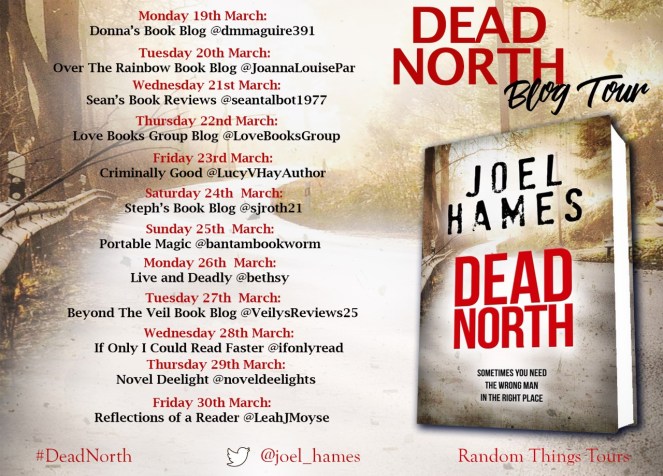
Follow The Blog Tour:
If you like the sound of this book from this extract do follow the blog tour and find out what these other bloggers are saying.

 Over The Rainbow Blog
THANK YOU JO XX
LikeLiked by 1 person
My pleasure lovely xx
LikeLike