

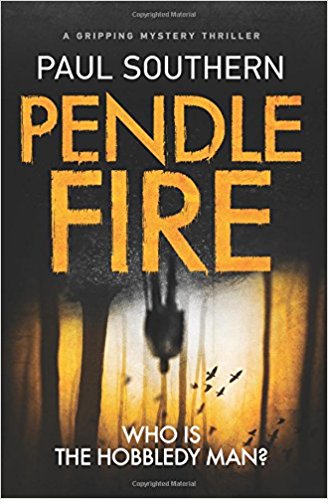
Book Description:
Pendle Fire was published on the 22nd March by Bloodhound books in ebook and paperback. The ebook is currently only 99p and you can purchase a copy here.
Guest Post by Paul Southern:
Beginning writing a new book is like seeing the summit of Everest on a clear day and thinking you’ll be able to walk up there in a t-shirt. It’s a moment to be savoured. The rest of the climb may be full of dead-ends and false dawns, despairing plunges into abysses of uncertainty and crevices of doubt but, if you’re lucky, you’ll reach the summit some years later with your manuscript in hand. What is sure, however, is that the original idea you had on that clear day will have changed dramatically. When you look back down the mountainside at the route you’ve taken, you will realise how difficult and arduous was the journey, and how much you had to adapt it to keep it going. Writing a book is a slog, not a sprint.
The original idea for Pendle Fire came in 2008, when I was thinking of plots for a prospective TV series called Nightfall. Several episodes had been sketched out by a close friend of mine, the title of one being The Hobbledy Man. The plot of this episode wasn’t really fleshed out, but a line from the description always stayed with me: ‘The children on a local estate have a superstition about the Hobbledy Man who comes out of the shadows in the underpass: they believe the sighting of him is a precursor of the ending of the world.’ From that simple sentence, the seed of Pendle Fire was planted and over the years took root. The Hobbledy Man preyed on my mind and would not leave me.
The series was to be set in Lancashire (one episode was called ‘Lucifer Over Lancashire’ after The Fall’s song) and end up on Pendle Hill, where some great conflagration would take place. Pendle Hill is, of course, the home of the Pendle Witches. The witch trials of 1612 saw many innocent people lose their lives and set the established Church against the theology of witchcraft. King James I himself was sceptical of the evidence against them but it was his book on the subject, Daemonologie, which advocated their prosecution. I have always been interested in the twilight realm that exists between the possible and the impossible (see Killing Sound, 2014), and this historical basis added an extra layer of interest in the area and turned me towards the hill.
I like to know a place intimately before I write about it, so I took the first train up to Colne and went walking. I visited the Black Moss reservoirs and trudged through Aitken Wood and, all that day, a mist lay over the Pendle valley. The book started to take shape. Eerie locations appeared to my left and right – abandoned farmsteads, hillsides full of bracken and gorse, dark paths that led into stricken woods. This could easily be the birthplace of the Hobbledy Man. Belief in witchcraft may largely be dead, but it was easy to imagine what it must have been like at the time of the trials when old Demdike sold her soul to Tib. There is something wild and abandoned about the region still, something uncontained and dangerous. I now had a character and a location, I had historical links. I had atmosphere. What I needed now was a plot.
On the way back, I passed through the towns of Nelson and Burnley. They are typical of many in Lancashire, faded relics of a bygone age, old mill towns with nothing now to spin, with divided communities living cheek by jowl. In their own way, they seemed as abandoned and desolate as the hill.
When I returned to Manchester, the first thing I did was read about them. The local Burnley and Nelson newspapers were a mine of information. I wanted to get a feel for these places, hear what the local people said. What do the young people do? What happens at night? The answer appeared to be very little. Or, at least, very little which was spoken about.
In recent years, many northern towns have been plagued by grooming gangs. The national publicity given to cases in Rotherham and Rochdale has highlighted the issue. Sadly, these investigations are very much the tip of the iceberg. The polarisation of communities in northern towns has not helped community relations; nor has it allowed the authorities to effectively deal with the problems till it’s too late.
My first two books (The Craze and Brown Boys in Chocolate) were multi-racial crime thrillers that dealt with many issues in both the Muslim and white communities in Manchester. A novelist should never shy away from controversial subjects. If you find that you’re censoring yourself when you’re writing, then you’re doing what too many people have done in abuse cases. You’ve looked away and said nothing. I did the opposite. I started to talk to people on the ground and in authority.
Almost overnight, Pendle Fire had a contemporary political thread. Whereas, in the 17th century, the Devil’s work was seen in the practice of witchcraft and the exploitation of women, today it could be found in the practice of child abuse. The Devil was the master illusionist, blamed for tempting people to commit crimes. He knew the constitution of men and could take advantage of them. Conjury, lechery and magic were his calling cards. There was a casual offloading of guilt and responsibility which opened the door to the moral puritanism of the witchfinders. Today, that offloading has led to the suffering of too many vulnerable children, too much wringing of hands, and no solutions.
I had seen my Everest, or more aptly, Pendle Hill, now. It was not a clear day and it would have been impossible to get up there in a t-shirt, but the analogy still held true. It was the moment when I could see the way to the top and write the book. It was not till years later that I got it finished, of course, but in the end it didn’t let me down and I hope I didn’t let it down. I believe a good book should make you think at the same time it entertains. I hope you will be as changed when you read Pendle Fire as I was when I wrote it.
Thank you very much Paul for writing such a fascinating guest post.
About The Author:



My family live in Nelson & Burnley. I was born in Burnley general! 😉
Definitely gonna buy this book! 💖📚🤓
LikeLike