
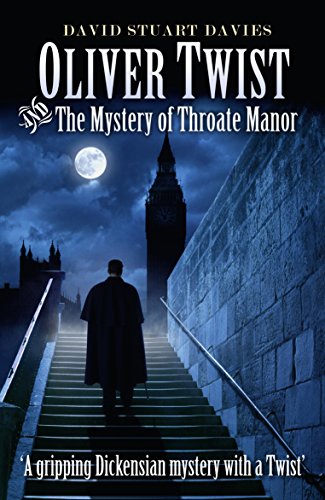
Happy weekend everyone! I’m on the blog tour for Oliver Twist And The Mystery Of Throate Manner today and have a great interview with the author to share with you.
Oliver Twist And The Mystery Of Throate Manner is available now in ebook and paperback, the ebook is currently only 99p. You can purchase a copy of both here.
Before I share my interview with you here is a little bit about the book.
Book Synopsis:
Oliver Twist is a young man in his late twenties and employed as a solicitor. He has taken his old associate Jack Dawkins, aka the Artful Dodger, on as his clerk in attempt to civilise him and keep him out of trouble. Together they become embroiled in a dark and dangerous murder mystery.
Throate Manor is the ancestral home of the Throate Family in Surrey. The latest incumbent of the line, the aged Sir Ebenezer, trapped in a loveless marriage to Lady Amelia, is being terrified by a night visitor, a sheeted apparition who appears in his bedroom, and warns him to remember his son. This does not refer to his legitimate offspring Jeremiah Throate, a reckless gambler and libertine, who is deeply in debt to Eugene Trench, a sinister figure in the Victorian underworld. The son to whom the apparition refers is an illegitimate child Sir Ebenezer fathered with a maidservant some twenty five years previously. Fear mixed with guilt prompts Sir Ebenezer to try and locate the son he has never known. He plans to alter his will to favour him. He contacts his solicitors, the firm of Gripewind and Biddle, for this purpose and they despatch Oliver Twist and Jack Dawkins to Throate Manor to attend to this business. Sir Ebenezer charges Oliver with the task of finding his lost son.
The task is a perilous one leading to violence and murder before shocking revelations threaten to destroy them all.
Bestselling crime author David Stuart Davies delivers a unique Victorian set mystery, reimagining some of Charles Dickens best loved characters in new and thrilling roles. Ideal for fans of Kim Newman, Mark Frost and the author’s acclaimed Luther Darke series.
Interiew with David Stuart Davies:
1. Can you tell us a little bit about yourself?
I live in Huddersfield in Yorkshire and started out as an English teacher. I was able to jump ship over twenty years ago and do what I’d always wanted to – to write.
I work best on my new creative writing in the mornings from around six o’clock, before having a shower or getting caught up in real life. My mind is really clear then and I leave editing until later in the day.
My most recent series of novels (Blood Rites was the final one in the trilogy, published by Urbane in 2017) was actually the first I’d set in my home town of Huddersfield. The DI Paul Snow series is very dark Yorkshire noir – he’s gay, facing prejudice in the police force of the 1980s
I’ve written a lot about Sherlock Holmes: eight novels, two plays and three non-fiction books as well as numerous articles and introductions about the character.
I am happily married to a wonderful and tolerant woman who reads and checks everything I write – even my shopping lists.
I am on the national committee of the Crime Writers’ Association and edit Red Herrings, their magazine. I am proud to be a member of the Detection Club formed in the 1930s by Dorothy L. Sayers and G. K. Chesterton – a dining club for crime writers.
2. What do you do when you are not writing?
When I’m not writing I do pretty boring, essential stuff – working from home I end up cleaning the loo, doing the ironing and defrosting the fridge while my wife is out at work. I’m much better at it than she is!
I love eating out and meeting friends for a good conversation. I enjoy reading, which is probably a fairly obvious thing for a writer to do – though I find it hard to read: if I’m blown away by a novel I fall into despair, thinking that I’ll never achieve anything a tenth as wonderful in my own writing. And if the book I’m reading isn’t engaging me as I’d hoped, I get distracted thinking about how I’d have written it more effectively. It’s hard to leave your own insecurities behind sometimes and just enjoy the ride. I read best between books and on holiday, and I read a lot of non-fiction to prevent myself from falling into the malaise mentioned above.
I also adore watching old films. I’m very fond of horror movies from the golden age of Universal and Hammer. The kinds of friends I hang around with also tend to be classic film geeks and you can often find us nattering away about the oeuvre of Peter Cushing or Boris Karloff.
3. Do you have a day job as well?
No day job but, like most writers, I have several strings to my bow in order to keep the wolf from the door – and writing in clichés probably doesn’t count as a job! As well as editing the Crime Writers Association’s monthly magazine Red Herrings, I’m the general editor for Wordsworth Editions Mystery and Supernatural series.
4. When did you first start writing and when did you finish your first book?
I started writing before I was ten. I used to write little stories for my mother. But in a serious way it was in my mid-teens that I attempted to create new Sherlock Holmes stories. My first published book was written when I was at university. See the response to question 10.
5. How did you choose the genre you write in?
I’ve always loved crime fiction – ever since I encountered The Hound of the Baskervilles in the school library when I was about twelve. The book had as much of an impact on my life as if the hound itself had jumped howling from the library shelves. I fell in love with the character of Sherlock Holmes and when I’d exhausted Conan Doyle’s originals I started writing my own Holmes stories for fun – what today would be called fan fiction. Holmes eventually led me to other detectives and crime writers.
Similarly ghost and horror stories have always been a favourite. It’s a simple case of tending to write about what I enjoy reading. If I don’t enjoy it, I feel that the reader would somehow see through me and they wouldn’t be convinced by the fictional world I’d created either.
6. Where do you get your ideas?
Mainly they just appear – out of thin air, as the saying goes, or in my case out of a wall of fog and black and white cinematography. I am lucky to have a vivid and visual imagination. But obviously I’m also influenced by everything around me – whether it’s other books, overheard conversations, news stories, drama or films. For me, it’s films particularly – when I visualise a scene in a novel, I see it cinematically in my head. But my ideas come from anything and anywhere really – writers are like hoovering vultures with an eye on the recycling bin.
7. Do you ever experience writer’s block?
Yes, from time to time I do! Rarely when I’m actually writing a book but usually when one project is finished and it’s time to start a new one. That peculiar gap between ending one fictional world and leaping into another: what do I want to do next? What should I do next? What can I do next? A writer should always think of the reader. I may love what I’ve created, and it would be great to write for the sheer joy of it, but will anyone else develop a love affair with my words? It would be nice to think that one person, one reader somewhere, really loved what I’d done – that it made them laugh or cry or be afraid to sleep at night and in some way allowed them to escape from reality for a little while. Art, literature and culture is so important right now in these uncertain times to give people a little boost.
However, in the end, when I’m wrestling with a new project at the back of my mind is always the question, will that big hairy wolf be kept from the door? It is a profession, which means that more often than not you write what you have to write rather than what you want to write. Most of the time I’m excited by what I’m doing and even if it wasn’t the route I intended originally I’ll try to find something in it to get me through. You have to discover ways to wriggle around and shape a project you may not be that keen on so that you can do what you love, do your best within that context, and surround yourself with other people who have the same passion.
8. Do you work with an outline, or just write?
I start with an idea, a notion and a very vague sense of where it will lead – then I just write. There are some authors who plan everything carefully before actually writing their novel and do a lot of research. I use broad brush strokes and I couldn’t plan. I enjoy the journey too much, never quite sure where the road will lead. I’ve never thought, I’m going to write a novel about X which will appeal to market Y and be particularly relevant to current trend Z – that way lies the scary formulaic untruth. It is exciting and frustrating at times. New plot developments appear unbidden, as do some new characters. This can make it all the more exhilarating and I hope that if I’m excited by the process maybe some of that will translate itself into the completed work – and excite the reader.
9. Is there any particular author or book that influenced you in any way either
growing up or as an adult?
Well, it has to be Arthur Conan Doyle. Sherlock Holmes not only led me to a writing career, he has been a constant in my life and has made me many friends around the world. I think it is fair to say that I am well known in the international Sherlockian community having written fiction, non-fiction and two one man plays about the character as well as giving dramatised presentations at festivals and in libraries. And, indirectly, I met my wife through Sherlock Holmes!
10. Can you tell us about your challenges in getting your first book published?
This will really annoy people, I’m afraid. I was incredibly lucky and the first book I wrote, as a student, was accepted by the first publisher I sent it to! After that it was all downhill and it took me another 15 years to have another one published.
What happened was I was considering options for my final dissertation at university. I wanted to write about Conan Doyle but was told that he wasn’t a significant enough author. He’s on the National Curriculum now, but not then! As an antidote to this and for my own amusement I began to write an article about the films of Sherlock Holmes, which grew until I had a book length manuscript. I sent it off to New English Library and when I returned from my early morning milk round, which was earning me a student beer or two, there was a letter accepting the book.
When I went into teaching, I’d naively thought that I’d have loads of free time to write but the work was draining and nothing happened. In the meantime, I began writing for pieces for a commercial Sherlock Holmes magazine. This, helped me build a network and a profile in quite a niche area and helped me to get the next book out. Eventually I was offered the post of Editor of the magazine and so recklessly I jumped ship from teaching and became a full time writer.
11. Is anything in your book based on real life experiences or purely all
imagination?
Predominantly imagination. Particularly with this novel, which is set in the mid-Victorian period. The nineteenth century is well beyond living memory but it’s an era I’m immersed in and which is incredibly well documented, through increasing literacy, novels, newspapers and social documentary, as well as the thrilling new medium of photography.
I’ve always loved Dickens and A Christmas Carol is one of my favourite books. Maybe something of Oliver’s experiences – and Dickens’s own, as shown most explicitly in David Copperfield – as someone starting out in life and experiencing problems resonates with me. I came from a loving but very ordinary background with few educational opportunities early in life and it took a long time to be able to make writing my career.
I had great fun in working in a slightly different style in this book. I have not in any way tried to write like Dickens – I would not be so arrogant – but I hope I’ve captured the spirit and essence of his style. It is a crime and mystery novel – but then so were a number of Dickens’ tales. I have been able to include moments of drama, horror and humour and people the narrative with a wide range of characters, some of them comic, some grotesque and some engaging.
12. What was your hardest scene to write?
The first scene in a novel is usually the hardest to write for me. You have to produce prose where every word counts, capturing the flavour of the novel to come so that the reader is engaged and wants to continue the adventure. It’s really hard! With this book, I tried to set the tone of the narrative, demonstrating the stylein which the story will be told. Hopefully in describing Throate Manor and its occupants, the reader will sense the wit and colour of the prose.
13. How did you come up with the title?
I wanted ‘mystery’ and ‘manor’ in there to suggest the dark gothic elements of the novel, signaling to the potential reader that it might be something they’d enjoy. I also had my tongue in cheek – or maybe part way down my throat – when I added ‘Throate’ to the title. It suggested a sense of peculiar eccentricity and also a frivolous nod to the weird names Dickens includes in his novels.
I hope people don’t take this as a serious attempt to emulate Dickens’s style and depth – there’s no way any sensible author would even contemplate that. It’s my homage, aiming purely to entertain, a nod to his brilliance and a blatant theft of his characters – one of which I hope Fagin would have been proud. I’m hoping that Dickens doesn’t notice that he’s been dipped…
14. What project are you working on now?
At the moment I’m working on a detective series featuring Harry Black. He’s a private investigator working in 1950s London. I’m only at the early stages with this first novel but the character and the period, with its post-Windrush racial tensions is really exciting me. As a man of colour operating in that era, the issues Harry faces seem very alien sixty years on, but unfortunately many of them still resonate in today’s society.
15. What has been the toughest criticism given to you as an author?
Well, rejection is always tough to take but it is part of being a freelance in any profession – you create your stuff lovingly, you put it out there, you audition or tout your wares, but if it’s the right stuff in the wrong place at the wrong time you’ll get nowhere. Hard work and talent are not always enough – you need to create some luck as well.
The majority of writers experience rejection at some time, even the most successful, and you have to try not to take it personally and just keep plugging away, hoping to encounter a decision maker in the future who ‘clicks’. The phrase that hurt me the most because of its subtlety was when a novel was returned with the comment, ‘this is not for me.’
What has been the best compliment?
The best compliment came from respected crime writer Peter James who said to me, ‘David, you can really write!’ That’s all I’ve ever wanted to have said of me. For a long time I really doubted my ability to write and whether I actually merited the term ‘writer’ at all, so to hear it from an author of Peter’s calibre was lovely – maybe he was just surprised!
16. Is there anything that you would like to say to your readers and fans?
Well, thank you for clicking on the link which took you to this Q&A – that’s lovely. And thank you for reading this far – I really appreciate it. Maybe you are that one reader out there who’ll love my work!
Now here comes the hard sell – please buy the novel! Writers are privileged to be able to spend their time creating characters and entertaining scenarios but in the end we need readers – and we need to sell books in order to live. While we write because we can’t stop ourselves, we also write because we need to – telling stories is a job, not a hobby.
Of course I hope that readers will enjoy Oliver Twist and the Mystery of Throate Manor. I feel that it’s one of my best attempts at creating a quality story. It’s a rich and multi-faceted narrative with enigma, humour and pace. I really enjoyed orchestrating my backdrop of pseudo-Dickensian types to people its pages, and taking Oliver and Dodger into an alternate adult life.
So, please buy the book, or if you don’t fancy it yourself, think of a friend who would. Thanks so much for reading
About The Author:

David Stuart Davies is an author, playwright and editor. His fiction includes six novels featuring his wartime detective Johnny Hawke, Victorian puzzle solver artist Luther Darke, and seven Sherlock Holmes novels the latest being Sherlock Holmes and the Ripper Legacy (2016). His non-fiction work includes Starring Sherlock Holmes, detailing the film career of the Baker Street sleuth. David is regarded as an authority on Sherlock Holmes and is the author of two Holmes plays, Sherlock Holmes: The Last Act and Sherlock Holmes: The Death and Life, which are available on audio CD. He has written the Afterwords for all the Collector’s Library Holmes volumes, as well as those for many of their other titles. David has also penned three dark, gritty crime novels set in Yorkshire in the 1980s: Brothers in Blood, Innocent Blood and Blood Rites. He is a committee member of the Crime Writers Association and edits their monthly publication Red Herrings. His collection of ghost and horror stories appeared in 2015, championed by Mark Gatiss who said they were pleasingly nasty. David is General Editor of Wordsworth’s Mystery & Supernatural series and a past Fellow of the Royal Literary Fund. He has appeared at many literary festivals and the Edinburgh Fringe performing his one man presentation The Game’s Afoot an evening with Sherlock Holmes & Arthur Conan Doyle. He was recently made a member of The Detection Club.

 Over The Rainbow Blog
Really really enjoyed this and love the sound of your book:)
LikeLike